b. 1971
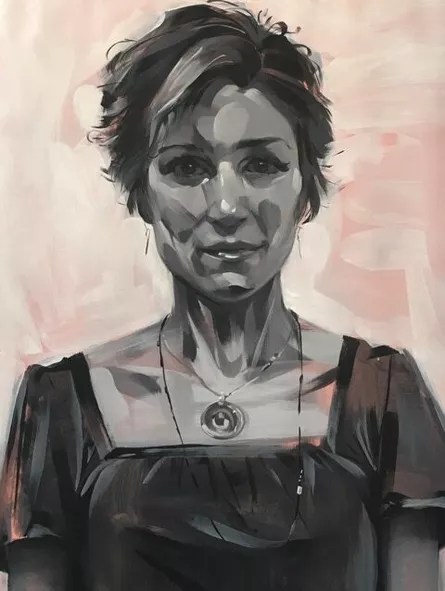
While Rebecca Campbell’s art encompasses painting, sculpture, and installation, she is best known as a portrait painter of women. She explores the complexity of identity and quietly addresses gender issues that take place in the art world. She rails against the idea that people, some of whom she actually knows, believe that if you are a mother and an artist, you are either a bad mother or a bad artist.
In 2015, Campbell began her “You Are Here” series where she paints portraits of every woman artist she knows to emphasize the lack of gender equity in the art world. She wants to stop these educated, talented, innovative female artists from disappearing as many of them are missing from the public sphere of biennials, gallery shows, and museum exhibitions. She also realized that she did not have any female artists of color in this series and has now been correcting this omission.
Campbell was born in Salt Lake City, Utah the youngest of seven children in a strict Mormon family. She always questioned the Mormon church and the role it ascribed to her gender. “I grew up in a fundamentally patriarchal system. Men were granted supernatural powers from god and women were left to fend in the ordinary bodies allotted them.” She spent her teenage years making art but was told by her church elders that she should not attend college because it would make her unhappy.
She left the church and moved in with her boyfriend Todd (who would later become her husband and father of her children) to study at Pacific Northwest College of Art in Portland. Her father, a successful business man and Mormon Bishop, wrote to her saying that she was a disappointment to him. She continued to study art and received her B.F.A. in 1994. In 2001, she earned her M.F.A. from UCLA and taught painting and drawing at the University of California, Fullerton for many years.
“My work usually begins with an autobiographical impulse, but it never stays solely in that territory and almost never tells a linear autobiographical story.” Her 2013-2016 “The Potato Eaters” references the early painting of Van Gogh as she uses archival family photographs as source material for her painting of relatives, some of whom died before she was born. She continues the exploration of her childhood and family with paintings of her own children, blending figuration with abstraction by layering with broad brush strokes.
Since her work is autobiographical she puts ‘motherhood’ into her series of paintings of mothers and her own children. She feels that focusing on motherhood has caused her work to be treated differently than the works of other artists. She has stated that while motherhood is beautiful, it is abhorrent too. In her 2010 painting “Mary Had a Little Lamb,” the mother in the painting has a third arm – at first not noticed by the viewer – which she needs to cuddle with her two children.
Campbell and her husband had two children when she became pregnant with twins several years ago. The two babies were born early, but both had pulmonary hypertension. Andromeda or Andi had to remain in the hospital while the more healthy baby, Josephine, went home with Campbell. However, while Andi was improving in the hospital, Josephine, the healthy twin, was the one who died in Campbell’s arms. The grief Campbell felt was almost unbearable, Andi remained in the hospital for four months and needed incredible amounts of care when she came home. Finally Andi survived and thrived. Campbell has stated that male artists – not female artists – are allowed to be broken in public.
In her painting “Art after Death” Campbell paints flowers and the space between the flowers. For her, the empty space between the flowers is the most important part of the painting because the thing that is not there – the flower, the baby daughter – becomes the all encompassing factor.
Campbell’s work is in the permanent collection of Los Angeles County Museum of Art, Laguna Art Museum, Brigham Young University, the Phoenix Art Museum, and others.
More here.
 The Women's Studio