b. 1967
Katrin Sigurdardottir is an Icelandic artist working in New York. While her background was in filmmaking, painting, and sculpture, she is best known for mixed-media installations which challenge ideas of space, memory, and perception. Sigurdardottir wants viewers of her installations to think about boundaries between reality and illusion.
Sigurdardottir studied at the Icelandic College of Arts and Crafts in Reykjavik. She received a B.F.A. from the San Francisco Art Institute and an M.F.A. from the Mason Gross School of the Arts, Rutgers University. She recently was named the next Charles C. Bergman Endowed Visiting Professor in Studio Art in the College of Arts and Sciences at Stony Brook University.
The artist examines distance and memory through shifts in scale in architecture, cartography, archaeology, and geology. Her works question the authenticity of real locations and our account of them. She employs traditional sculptural techniques and works with aspects of architectural model making and cartography. She makes models of real and imagined Icelandic topographies. Her series “Unbuilt Residences in Reykjavik, 1925-1930” consisted of sculptures modeled on architectural plans for unrealized structures in Reykjavik. The models she made were then destroyed by various means only to be reconstructed from the remains.
Her conceptual installations distort scale to challenge perceptions of time and distance. “I’m always thinking about distance. Human life is a transformation in scale. We go from being small to big, at least in most cases. In my work scale is a metaphor for memory and distance.”
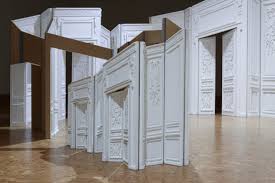
Sigurdardottir makes miniature replicas of buildings such as her childhood home and her elementary school in the series “Ellefu” (‘Eleven’ in Icelandic). For an installation in 2010 at the Metropolitan Museum of Art she imaged rooms from two French Palaces. Her “Boiserie” was an almost-to-scale reproduction of a boudoir from France’s 18th century Hotel de Crillon. She made detailed replications of its carvings, gilding, furniture, and chandelier. It was an enclosed space that a viewer could circumnavigate, peering in through windows. A second room in a different Met gallery came from the Hotel de Cabris, and it is the opposite of the Crillon’s boudoir. The Cabris piece was an open construct and consisted of a series of unfolded panels, resembling a theater diminished in size to dollhouse proportions. It spiraled around as if seen through a looking glass.
“Metamorphic” (2017 – present) is an installation consisting of cobblestones, made from Icelandic clay and installed in foreign locations. The stones are constructed with fragile plaster that Sigurdardottir has to repair after having been broken in shipping. Because of the stronger materials she uses in her repai,r she is able to reinforce the objects’ strength. Sculptures, that are originally cast in a soft material, will start to erode as they are moved into different exhibits. Each time that happens, Sigurdardottir replaces missing parts with more resilient material and renews the sculptures.
She has exhibited in the 55th Venice Biennial, the Sao Paulo Bienal, the Morocco Bienal de Rabat, and others. Recent solo exhibitions include New York’s Sculpture Center, Reykjavik Art Museum, Metropolitan Museum of Art, Chicago’s Renaissance Society, and Philadelphia’s Institute of Contemporary Art. She exhibited at the Eli and Edythe Broad Art Museum in Michigan 2019 – March 1, 2020 where she made an immersive 2,500 square-foot work in collaboration with a group of international college students.
More here.
 The Women's Studio