b.1970
French Moroccan multimedia artist Yto Barrada thinks of herself primarily as a photographer but also works in textiles, sculptural installations, and video art. Her research-based projects deal with various artistic, social, and political issues: fossil trade, Brutalist architecture in Tangier, colonialism, migration, and immigration.
Barrada is the co-founder and director of the nonprofit Cinematheque de Tanger, the first film archive and art-house cinema in North Africa. It is located outside Tangier’s historic Casbah district and is described by her as a place where art and social activism meet. Through this theater and her mixed-media art, Barrada offers a vibrant view of Morocco.
Barrada was born in France to Moroccan parents but grew up in Tangier which she considers her home. Her dual citizenship gave her the freedom of mobility to easily travel between North Africa and Europe.
She studied in Tangier, Paris, and New York. In Paris, she studied history, anthropology, and political science at the Sorbonne, and in New York she studied photography at the International Center of Photography. She makes photographs, films, sculptures, and installations that explore the social, political, and historical life of Tangier, the city on which most of her work is centered.
Barrada investigates construction sites, natural landscapes, ecology, gardening, textiles, poster art, geology, paleontology, urban life, and the divides between continents. Her 2004 “Plate Tectonics” is a wooden model of the world with moveable continents.
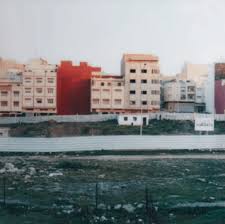
She focuses on roads, ditches, and holes in Tangier, encountered by thousands of Africans as they cross the Strait of Gibraltar to enter Europe. For her 1998-2003 series “A Life Full of Holes: The Strait Project” she photographed the Strait of Gibraltar and life on the Moroccan side, stressing the colonial relationship between North Africa and Europe.
“All my work explores strategies of survival, of resistance, in conditions of constraint. The constraint can be oppression or domination.” Such resistance can be seen in her 2005 video, “The Smuggler,” which showed an elderly woman hiding clothes in her coat which she could sell as she traveled. Five years later she made an installation called “Play [Play (Lyautey Unit Blocks), 2010], which consisted of 30 large wood pieces shaped like children’s block toys and painted in bright reds, blues, yellows, greens, and blacks. They were stacked like building blocks with some on the floor or some angled and ready to be assembled. She recalled that her mother “was a therapist and took care of a lot of broken kids” but had limited time for her own children. Barrada does not “play cards or games or sports. I only play in the work. . . ” as seen in this piece.
Her almost 30-minute long video, “Continental Drift,” is a wide-ranging excavation of the many layers of Tangier. It includes an interview with one of her “Tangier eccentrics;” a picture of the man who kidnapped her grandfather, who was never seen again; people working in the marketplace; and footage of ice floes from Antarctica.
Barrada was a visiting artist at UCLA and has exhibited at the 2007 and 2011 Venice Biennale, Performa, Tate Modern, Centre Pompidou, Museum of Modern Art, and the Metropolitan Museum of Art. She had a solo exhibition at the Stedelijk Museum. Her work was in ICA Boston’s “When Home Won’t Let you Stay” 2019-2020 and in the “Whitney Biennial 2022: Quiet as It’s Kept.”
More here.
 The Women's Studio