b. 1981
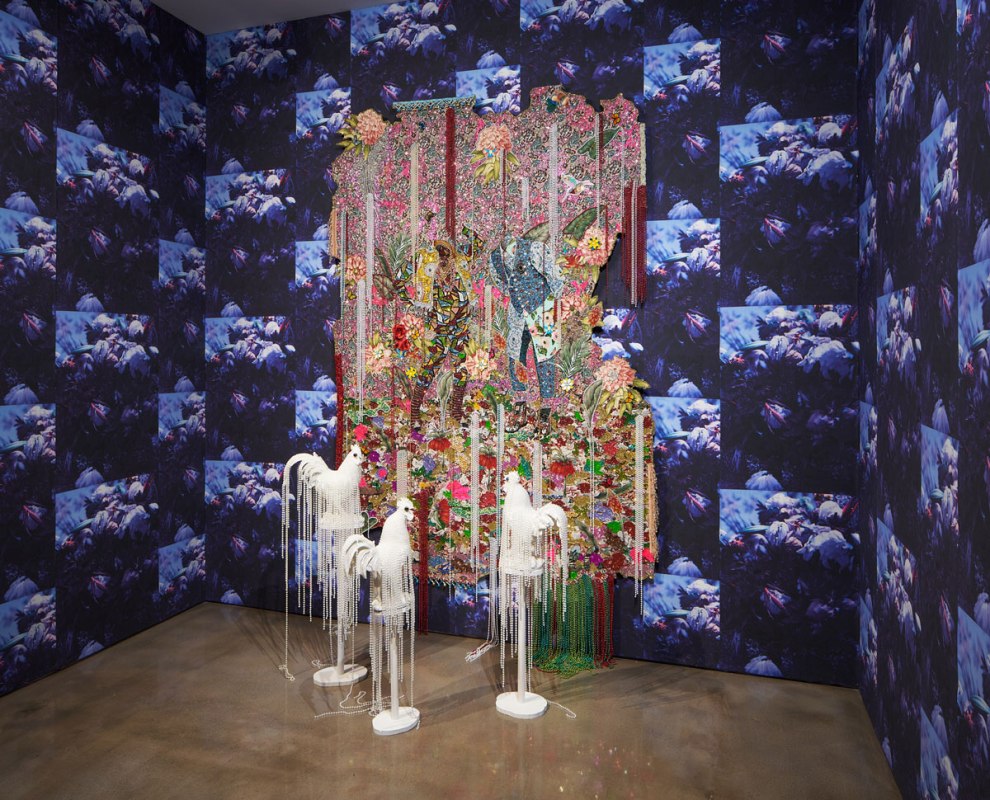
Mixed-media artist Ebony G. Patterson, born in Jamaica, is based in Chicago and Kingston, Jamaica. Patterson creates a multilayered practice in painting, sculpture, installation, performance, and video art. She uses the beauty of tapestry, beading, sequins, crocheting, and photography to address injustice. Floral patterns are often the backdrop of her work. While Patterson sees flowers as decorative and beautiful, she uses gardens in her art as a metaphor for people living in a postcolonial world. Her work addresses gender, racial, social, political, and global issues in colorful pieces that are strong, vivid, and beautiful.
Patterson received her B.F.A. from Edna Manley College in Kingston, Jamaica in 2004 and an M.F.A. from Washington University in St. Louis, Missouri in 2006. In addition to teaching at her alma mater in Kingston, she taught at the University of Virginia, the University of Kentucky, and the School of the Art Institute of Chicago.
Each of her works begins in her studio with an elaborate photoshop. She poses local people in opulent costumes that reference beauty and pageantry. She prints and edits the photos and sends them to a weaver who works them into a tapestry on a Jacquard loom. Patterson takes the tapestry, stiffens the fabric, and cuts parts out to make the initial form. She collages the form by adding fabric, embellishments, jewelry, and glitter to turn the piece into a kind of sculptural work.
Darker issues of gender inequality, racism, colonialism, and violence reside beneath the richness and luxuriousness of the glitter, jewelry, and immersive garden imagery. Patterson wants the beauty of her art to lure a viewer into looking at each piece closely. When viewers do this, they will realize that the drawn or painted figures, entangled in flowers or jeweled objects, are disembodied persons. Some of the figures are lying ghost-like on the ground in a tangle of plant life that resonates with violence and death. In her 2015 “found among the reeds – dead trees” is the recumbent body of a dead man in the foliage. His body becomes one with the environment like the bodies of actual men who were murdered and dumped like garbage and often never found.
Some of the figures in her art are headless, such as one from her solo exhibition, “. . . when the cuts erupt . .. the garden rings . . . and the warning is a wailing … .“ In this particular tapestry, the larger-than-life woman is painted wearing an elaborately decorated gown. Her arms are raised above in a dance-like gesture. Patterson notes that from the top of her neck, “there is life sprouting, so I’m thinking about notions of regeneration, and the garden as a site of restoration, rebirth, burial and violence.”
In 2021, Patterson made a public work that covered the facades of buildings in Philadelphia. Her four large-scale works showed headless, monumental figures in imaginary gardens, with text taken from poetry. These works gave credit to the labor of Black women, especially those women who marched in protest, took care of the sick, and mourned the dead.
Her work has been exhibited at the Institute of Contemporary Art San Jose; Monument Lab in Philadelphia; Contemporary Art Museum St. Louis; Museum of Contemporary Art, Chicago; The Studio Museum in Harlem, and ICA San Jose. She has received awards and fellowships including the David C. Driskell Prize, Tiffany Foundation Grant, and the Joan Mitchell Foundation Art Grant, and others.
Her work is in the permanent collections of the Los Angeles County Museum of Art, Brooklyn Museum, Studio Museum in Harlem, the Whitney Museum of American Art, Perez Art Museum, among others.
More here.
 The Women's Studio