1896-1942
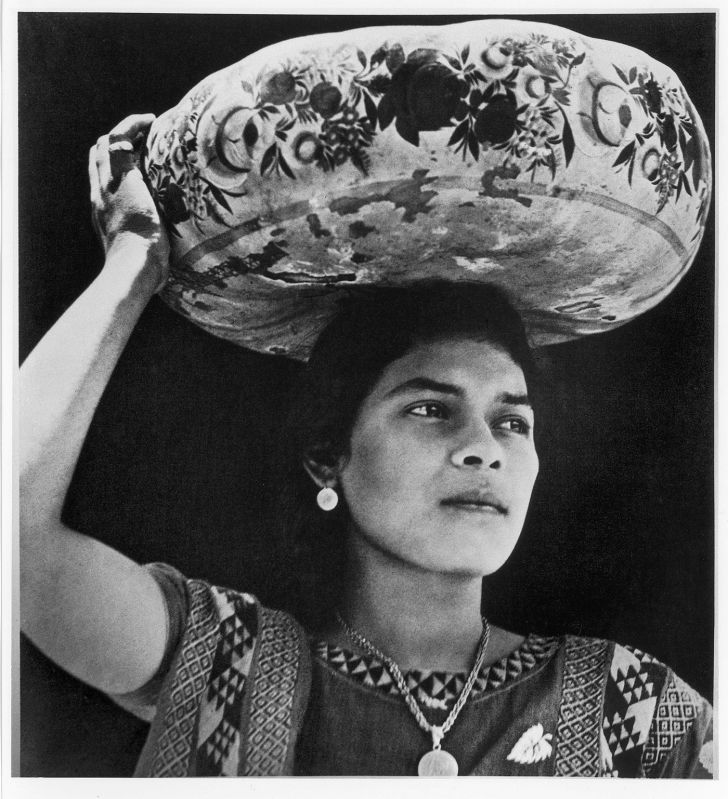
Tina Modotti was a photographer whose bare, essential style led her to seek a direct and immediate communication with the people she photographed in Mexico.
She was born into a poor socialist family in Italy and became a factory worker at the age of fourteen. In 1913, at the age of sixteen she emigrated to San Francisco where she worked in a textile factory. It was living in San Francisco from 1913 to 1922 that Modotti became interested in the culture and art of Latin America. She made her way to Hollywood and acted in a few movies. In 1915, she married the painter and poet Roubaix de l’Abrie Richey, who visited Mexico in 1922 but fell sick and died before Modotti could reach him.
In Southern California she met the photographer Edward Weston in 1921, who became her lover and instructor. In 1923, Weston left his wife to join Modotti in Mexico City where they lived and photographed together for three years. She became his model, collaborator and lover. At times Modotti was better known as his mistress than as a photographer. From him, she learned to use unconventional perspectives, simple forms, sharp focus, and tight compositons.
In 1924, her iconic photograph “Roses” became one of the most famous in the history of photography. Modotti placed four roses on their side and not upright. Gravity pressed the petals of the middle two flowers into an oval, making for a sensuous, voluptuous image rendered in a golden brown shade.
After Weston returned to California, Modotti continued to live in Mexico City where she dedicated herself to photography and politics, portraying the lives and habits of the Mexican people with sincerity. She associated with artists such as Diego Rivera, Frida Kahlo, David Alfaro Siqueiros, and Jose Clemente Orozco. Many of the published photographs of Rivera’s frescoes were made by her.
In 1927, she joined the Communist Party of Mexico. She worked for various newspapers and was involved in intense political activity for the Communist party. She stopped photographing flowers and architecture to focus on the Mexican masses. She portrayed young and haggard people and made still-life photographs such as a bandolier full of bullets crossed by the neck of a guitar with an ear of corn between them. Often there would be a sickle or hammer cast in shadows in her work.
In 1930, she was expelled from Mexico. She lived in Germany and later in the Soviet Union where she continued her political involvement. In 1936, with the outbreak of the Spanish Civil War, she volunteered for the Red Cross service in Spain. In 1939, she returned to Mexico by way of the United States, In 1942, she died – some say killed – in an auto accident, possibly killed by Communists because she was planning to break with the Party.
In 2010 Modotti’s work was shown in her largest exhibition in Vienna. Modotti’s prints are in the collection of New York’s Museum of Modern Art, Metropolitan Museum of Art, Philadelphia Museum of Art, and MoMA San Francisco.
More here.
 The Women's Studio