b. 1940
Jaune Quick-to-See Smith of Metis-Cree and Salish descent, has lived in New Mexico since the 1960s where she paints – primarily in oils and acrylics – and makes prints. She describes her art as ‘nomad art’ because it varies in genre as she paints figurative, landscape, and semi-abstract works. Her art tells a story as her paintings use maps, signs, petroglyphs, rough drawings, and the inclusion and layering of texts.
“I was born at the St. Ignatius Mission on the Flathead Reservation at a time when one in 10 babies born there lived.” She grew up with three families in a one-room cabin without furniture, plumbing, or electricity and was hungry and sick all the time. “That was a normal upbringing for someone my age.” She attended community college and knew she was to be an artist. However, her teacher told her that even though she was the best one in her class, she could never be a true artist because she was a woman. This, of course, did not stop her but heightened her love of paint and her need to create her own art.
She emerged in the 1980s as one of the foremost Native American artists who was committed to feminist and indigenous issues. Smith considers herself a conduit, a carrier of overtly political messages. For forty years she has made art that addresses issues important to Native people, especially regarding the environment, cultural preservation, racism, and the stereotyping of Indian identity.
In 1991 she exhibited “Paper Dolls for a Post Columbian World,” a faux activity kit for children portraying the Plenty Horses family – Barbie the mother, Ken the father, and Bruce the son – as well as the Jesuit priest who converts them.
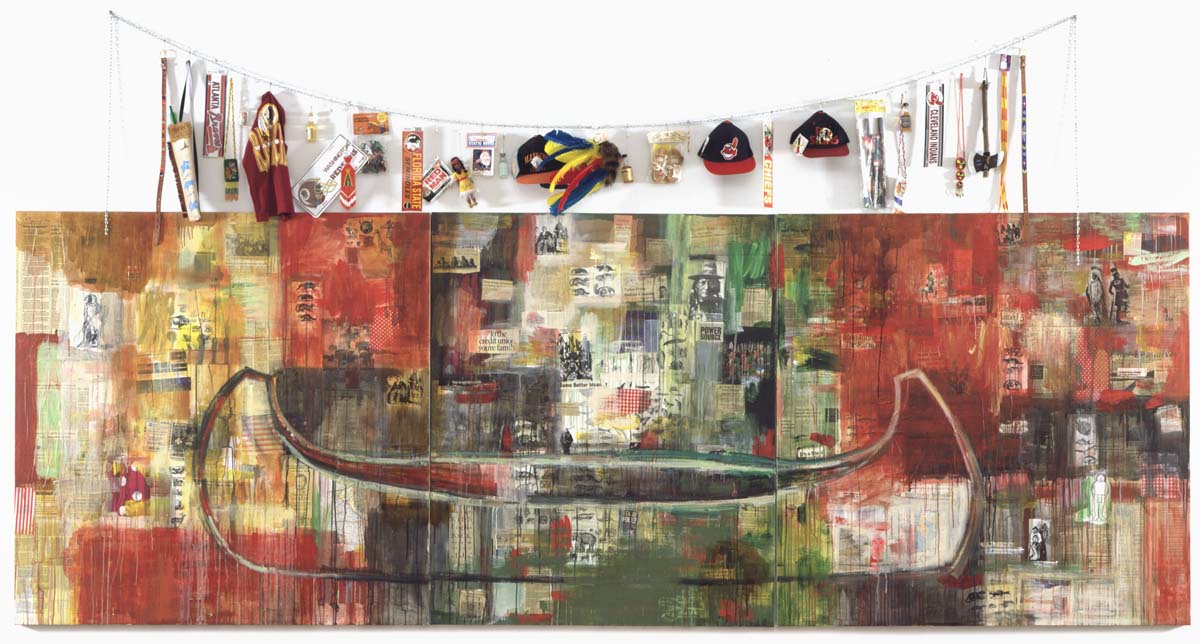
She was part of the Native American response to the 1992 Quincentennial of Christopher Columbus’s first voyage. She curated a show that was produced by Atlatl, a national Native arts organization. Her statement in the show’s catalogue reads: “Columbus personally began one of the world’s major holocausts . . . (His men) . . . “beat, raped, tortured, killed, and enslaved 300,000 Taino Indians (in the Caribbean) within 15 years.” In her “The Quincentenary Non-Celebration” she employed a strong contour outline of a figure: a horse in “Go West Young Man;” a canoe in “Trade: Gifts for Trading Land with White People;” and a buffalo in a painting with the same name. She organized the most influential Quincentennial exhibition of Native photography, “We, the Human Beings,” for the College of Wooster Art Museum in Ohio.
Her “The Red Mean: Self-Portrait” is marked by the outline of her body, traced directly onto newspaper pages. Her pose, actually a double portrait of superimposed outlines, is a direct quotation of Leonardo da Vinci’s “The Vitruvian man” c. 1492. In place of the ideal man’s body, Smith substitutes her own, subverting the idea that all things are to be measured by European standards. She even translates geometry into indigenous terms, replacing the circle and square with the medicine wheel and symbol of the four directions. Her own bodily presence asserts, “I am here. We survived.”
In the recent exhibition at the National Museum of the American Indian, “Stretching the Canvas: Eight Decades of Native Painting,” one of the works presented was Smith’s 2015 “Trade Canoe: Adrift.” This acrylic painting showed a birch-bark canoe in front of a vivid yellow sky, floating on yellow and blood red water. The canoe is filled with constricted Syrian refugees, fish, and masks. In this painting she combines recognition of Indigenous land rights with various worldwide migrant crises.
She has been given numerous awards such as a grant from the Joan Mitchell Foundation to archive her work. Moore College of Art and Design gave her the Visionary Woman Award in 2011. She was given a Living Artist of Distinction Award, Georgia O’Keefe Museum in 2012, and she received a Lifetime Achievement Award in 2014.
Her works were included in many “Quincentennial Response” shows in 1991-93. One of these works, “I See Red: Target,” was the first painting by a Native American artist to enter the permanent collection of the National Gallery of Art, which did not have a show on Native art for 30 years. Her retrospective “Memory Map” was shown at the Whitney Museum of American Art in 2023 and was the first retrospective ever given by the museum for a Native American artist.
Her works are in the permanent collections of the Whitney Museum, Smithsonian American Art Museum, Brooklyn Museum, Metropolitan Museum of Art, New York’s Museum of Modern Art, and London’s Victoria and Albert Museum.
More here.
 The Women's Studio